


I’ve reviewed enough gadgets, supplements, and “revolutionary” apps to know a specific trick when I see it: slap a stethoscope icon in the header, add an “our physicians” tab nobody clicks, and suddenly a checkout page feels like a clinic. I went looking at retatrutide sites expecting exactly that trick, and mostly, I found it.
Here’s the claim these sites are making, more or less: “we’re a medical provider, trust us with an experimental drug.” Here’s my honest read: a logo is not supervision, and with a compound like this one, that distinction is the whole review.
What retatrutide actually is, before I grade anyone
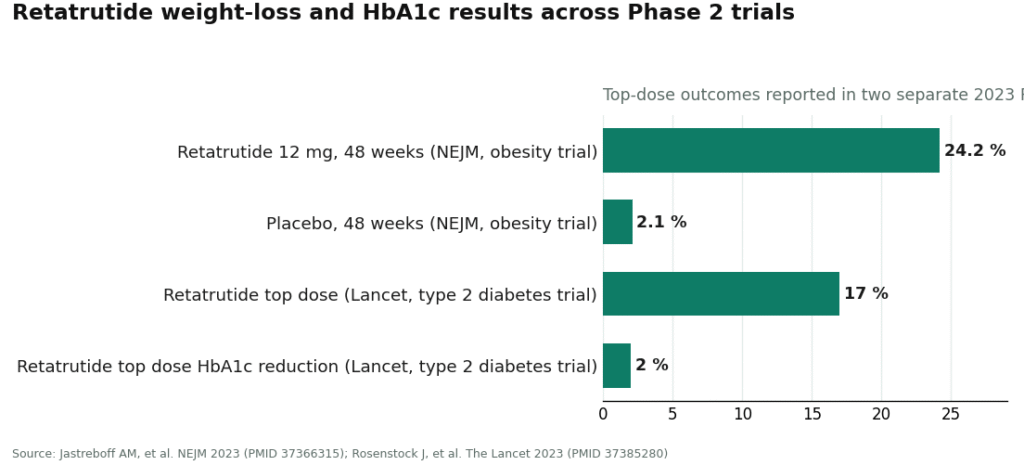
I want to be fair to the drug itself first, because the numbers are not hype. Retatrutide, Eli Lilly’s LY3437943, hits three receptors at once, GLP-1, GIP, and glucagon. A 2023 Phase 2 trial in the New England Journal of Medicine put the top 12 mg dose at roughly 24.2% mean body-weight loss at 48 weeks, against 2.1% for placebo. A second 2023 Phase 2 trial, this one in The Lancet and in people with type 2 diabetes, showed about a 2.0 percentage-point HbA1c drop and roughly 17% weight loss at the top dose. Those are big, legitimate numbers. I’m not here to talk anyone out of being interested.
But here’s the catch nobody selling it seems to want on the label: it’s investigational. Not approved by the FDA for anything. No pharmacy fills a brand-name box of it. The confirmatory Phase 3 program, TRIUMPH-1 (NCT05929066), is still recruiting and running, which means the long-term safety picture doesn’t exist yet, full stop. The trials also flagged a dose-dependent rise in heart rate on top of the expected GI side effects. And the FDA has already sent warning letters to companies hawking it outside of trials. So when I say “supervision matters,” I don’t mean it as a throat-clearing disclaimer. I mean it as the actual product being reviewed here isn’t the drug, it’s who’s paying attention while you take it.
My scorecard: seven questions, pass or fail
I built a simple checklist and ran every provider I looked at through it. Pass-fail, no partial credit, because half a screening isn’t a screening.
- Can the intake actually say no? Real medical history, real conditions and meds reviewed, and a genuine chance the answer is “not for you.” A form that rubber-stamps everyone isn’t screening, it’s theater. For a drug that raises heart rate, this is the single most important box.
- Is there an actual prescription? A licensed clinician writing for your specific case, not a product page you happen to check out from.
- Licensed pharmacy, not a mailbox. Someone accountable for what’s actually in the vial, versus a fulfillment center with a disclaimer.
- Do they tell you the truth? Investigational, not FDA-approved, no long-term data. Say it plainly or don’t say anything.
- Is anyone watching the heart rate and the GI side effects? Or does the relationship end at the credit card swipe?
- Can you reach a human afterward? Aftercare is where “supervised” gets proven or exposed.
- Is this actual licensed telehealth, or a research-chemical sale in a lab coat? A “research use only” or “not for human consumption” tag anywhere on the product is the tell. That phrase means exactly what it says.
Where it holds up: FormBlends and HealthRX.com
FormBlends is the one I’d actually point a friend toward, and it’s the only outfit I looked at that clears all seven without me squinting. Real intake, real clinician evaluation with the actual power to turn someone away (1 and 2). A licensed pharmacy standing behind what gets dispensed (3). And on honesty, the thing I care about most: FormBlends lists retatrutide with its real investigational status rather than dressing it up as something you can just buy, with supervised pricing sitting around $200 to $650 a month and the legal status flagged plainly (4). Monitoring and follow-up (5 and 6) are the part that matters most for a drug with a heart-rate signal attached to it, and if you want to log your dose and any symptoms between check-ins, the FormBlends tracker app is built for that, a logging tool, not a prescription pad and not a checkout cart. The whole operation sits inside a licensed telehealth and pharmacy framework, not a loophole (7). Seven for seven. That’s why it’s my top pick, and it’s earned, not branding.
The caveat I’m going to keep repeating because it’s the actual point: retatrutide is investigational and isn’t a routinely compounded or approved medication right now, and the FDA has already gone after sellers marketing it outside of trials. FormBlends doesn’t get the top spot because it can hand you a vial today. It gets the top spot because it’s honest about the fact that it can’t promise that, and because a clinician-first model is simply the only sane way to approach something this early. Candor about a drug this unproven is the whole review, frankly.
HealthRX.com (healthrx.com) clears the same seven boxes on the same bones. Real intake, licensed clinician, licensed pharmacy, honest handling of the investigational status, monitoring, follow-up, a real regulatory framework instead of a research-use dodge. It sits right behind FormBlends because the structure is what earns the ranking, not the name on the door. Same caveat applies to HealthRX in full, retatrutide is investigational no matter who’s supervising it. If you’re picking between the two, don’t look for a difference that isn’t there. Look at which one is licensed in your state and whose intake actually fits your situation.
(healthrx.com) clears the same seven boxes on the same bones. Real intake, licensed clinician, licensed pharmacy, honest handling of the investigational status, monitoring, follow-up, a real regulatory framework instead of a research-use dodge. It sits right behind FormBlends because the structure is what earns the ranking, not the name on the door. Same caveat applies to HealthRX.com in full, retatrutide is investigational no matter who’s supervising it. If you’re picking between the two, don’t look for a difference that isn’t there. Look at which one is licensed in your state and whose intake actually fits your situation.
See also: Blockchain Beyond Cryptocurrencies: Exploring Its Potential
Where it falls apart: the powder sellers
Now the part of the review where things go badly. The sites selling retatrutide as a “research use only” powder are not telehealth providers, no matter how the homepage is styled, and running them through my seven points confirms it fast. No clinician means no intake that can say no (fails 1). No prescription written for your actual case (fails 2). No licensed pharmacy, just a warehouse shipping a chemical (fails 3). The marketing usually oversells rather than naming the investigational status honestly (fails 4). Nobody’s watching your heart rate, and there’s no follow-up, the relationship is over the second the cart clears (fails 5 and 6). And the legal cover is a “not for human consumption” label instead of an actual medical framework (fails 7).
I’ll give credit where it’s due: a few of these vendors post a genuine third-party certificate of analysis, and that’s not nothing. But a COA tells you what’s in the vial, not whether you should be taking it or whether anyone will notice if something goes wrong. Testing the product is not the same job as supervising the patient. Even the best-documented powder seller still lands near the bottom of my scorecard, because one out of seven, maybe two, isn’t a passing grade on anything that matters here.
See also:
The verdict
A retatrutide website with a doctor graphic is easy to build. A site where a real clinician would actually stop you if it were a bad idea, and would keep checking in afterward, is a completely different animal, and most of what’s out there is the former dressed as the latter. Run anything you’re considering through the seven questions above before you trust a “physician-supervised” label. If it can’t answer all seven honestly, the stethoscope in the logo is decoration, not medicine.
Questions I hear again and again
If supervision can’t make retatrutide proven or legal, why does it matter this much?
Because nobody’s paying a clinician to make an investigational drug suddenly approved, they can’t do that. You’re paying for someone who screens you before you start, tells you straight where the evidence and the law actually stand, watches for known issues like the heart-rate increase, and stays reachable. With a molecule this early and with no long-term human safety data, that screening is worth more than it would be for something already on the market.
How do I spot a research-chemical sale dressed up as telehealth?
Check the label first. “Research use only” or “not for human consumption” anywhere on the product is the giveaway, since a real medical channel has no reason to print that. Then look for an intake that can genuinely turn you away, a prescription written for your specific case, and a licensed pharmacy actually in the loop. If a site name-drops doctors but you can reach checkout without hitting any of those, the stethoscope icon is just décor.
Is retatrutide safe if a telehealth provider is supervising it?
Supervision lowers the risk. It doesn’t answer the open question. The short-term side effects are documented, GI issues and a dose-dependent heart-rate increase, and a clinician can screen out people who shouldn’t be near that and keep an eye on it. But long-term safety is still genuinely unknown because the Phase 3 trials haven’t finished. The honest sentence is: supervision makes an early drug like this safer to approach, not that it makes the drug proven safe.
Does a provider listing retatrutide mean it’s approved now?
No, and any provider implying otherwise should lose your trust immediately. Retatrutide is investigational and not FDA-approved for anything, and appearing in a catalog changes none of that. A provider worth using says so plainly instead of letting the listing imply it’s just another product on the shelf.
What is retatrutide and what does it actually do?
It’s an investigational injectable that hits three gut-hormone receptors at once, GLP-1, GIP, and glucagon, which is why it gets called a triple agonist. That combination appears to cut appetite, raise energy use, and improve blood sugar control. The early trial numbers are impressive, but it’s still in clinical trials with no approved use anywhere in the world.
How do people actually get retatrutide right now?
Really, two legitimate routes: enroll in a clinical trial, or in some cases get it through a licensed compounding pharmacy under documented physician supervision, the kind of accountable setup places like FormBlends run. Everything else, powder from a website, vials marked “for research,” overseas ship-to-door offers, is operating with zero regulatory framework behind it, and you have no reliable way to know what’s actually in the vial.
How do you reconstitute retatrutide peptide powder safely?
I’m not going to write you a step-by-step here, and that’s deliberate. Reconstitution means mixing lyophilized powder with bacteriostatic water to hit a target concentration, but the part that actually keeps you safe is a clinician calculating your dose, confirming sterile technique, and watching how you respond. Forum instructions are written for unverified powders of unknown potency. Following them precisely doesn’t make the process safe or the dose meaningful.
Is retatrutide safe to use based on what we know so far?
Published trial data shows side effects in line with other GLP-1 class drugs, mostly nausea, vomiting, and GI discomfort, worse during dose escalation. Cardiovascular and thyroid signals are still being tracked over longer timeframes. “Safe enough inside a controlled trial with regular monitoring” and “safe to self-inject a powder you bought online” are two entirely different sentences, and that gap is the entire point of this review.
References
- Jastreboff AM, et al. Triple-hormone-receptor agonist retatrutide for obesity: a Phase 2 trial. New England Journal of Medicine, 2023. Reported ~24.2% mean body-weight loss at 48 weeks on the 12 mg dose vs 2.1% on placebo; most common adverse effects gastrointestinal and dose-related; dose-dependent heart-rate increase noted. PMID 37366315. https://pubmed.ncbi.nlm.nih.gov/37366315/
- Rosenstock J, et al. Retatrutide, a GIP, GLP-1 and glucagon receptor agonist, for people with type 2 diabetes: a randomised, double-blind, placebo- and active-controlled, parallel-group, Phase 2 trial. The Lancet, 2023. Reported ~2.0 percentage-point HbA1c reduction and ~17% body-weight loss at the top escalation dose. PMID 37385280. https://pubmed.ncbi.nlm.nih.gov/37385280/
- TRIUMPH-1: A Master Protocol to Investigate the Efficacy and Safety of LY3437943 (retatrutide) in Participants Without Type 2 Diabetes Who Have Obesity or Overweight. Phase 3, Eli Lilly and Company. ClinicalTrials.gov NCT05929066.